
Digital coworkers: how AI agents are becoming part of enterprise operations
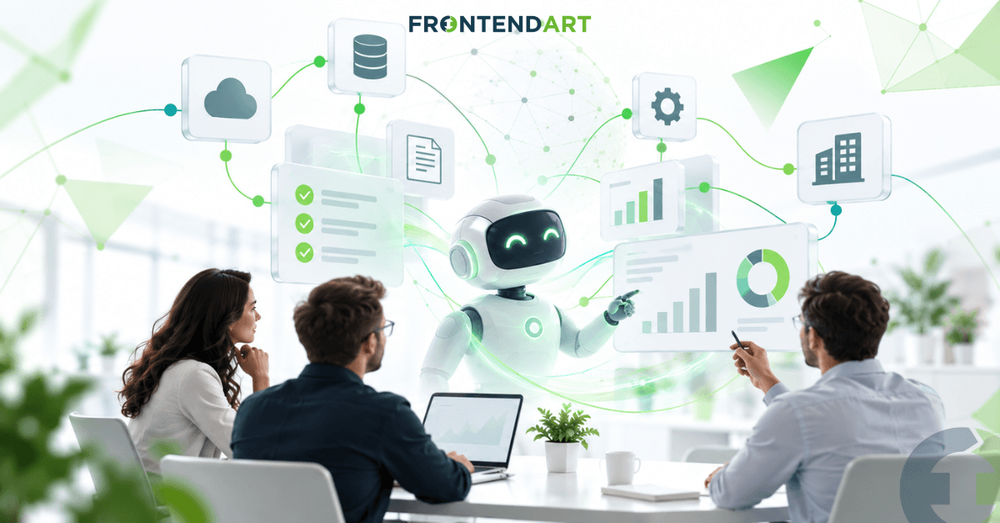
AI agents are taking enterprise AI beyond information retrieval and content generation toward active participation in business processes. By connecting to company data, documents, and enterprise systems, they can support multi-step tasks while operating within defined permissions and controls. This shift opens the door to a new generation of digital coworkers that work alongside employees as integrated parts of everyday operations.
The first wave of enterprise artificial intelligence was primarily about processing information. AI summarized documents, answered questions, generated content, and helped employees find the information they needed more quickly.
With the emergence of AI agents, however, a more advanced stage is taking shape. AI is no longer limited to providing information: within clearly defined boundaries, it can also participate in executing business processes. This could fundamentally change the way companies think about automation and the role of AI in their operations.
The next step is no longer another chatbot integration
The adoption of enterprise AI often begins with simple automations or the introduction of individual chatbots. Rule-based automation works well for predictable processes where it is possible to define in advance exactly which action should follow a given event. Chatbots and AI assistants, by contrast, primarily support users in their daily work, for example by searching for information, creating content, or answering questions.
More complex business processes often require more than this. Information needs to be interpreted, data must be collected from multiple systems, and the next step has to be determined based on the current situation. This is where AI agents introduce a significant change. They are not alternatives to custom enterprise software; instead, they can become an integral part of how these systems operate.
AI agents work toward a defined objective. They can plan the steps required to complete a task, interact with enterprise systems and data sources, and continue the process based on the results they receive.
The real value comes from connecting systems
An enterprise AI agent can create only limited value in isolation. To participate effectively in real business operations, it needs to understand the company-specific context, access the information it is authorized to use, and interact with other enterprise systems.
In a procurement process, for example, simply answering which supplier offers which terms is not enough. An agent could collect the relevant documents, verify the available data, compare supplier conditions, prepare a summary for decision-makers, and then forward it for approval. For this to work, AI needs to be treated not as a standalone application, but as an integrated part of the company’s existing IT environment.
Enterprise knowledge is one of the key foundations of AI agents
An AI agent can only operate reliably if it has access to the right information. In most organizations, however, business knowledge is scattered across PDFs, policies, databases, ERP systems, and other applications.
Because no two organizations operate in exactly the same way, AI agent implementations often require a degree of custom development as well. DocuART AI agents execute assigned tasks by working with the company’s authorized data sources and applications.
Users can ask questions or give instructions in natural language, while DocuART agents use the relevant enterprise data sources, documents, and systems depending on the task. When answering a question, they can gather relevant information and provide responses with source references. When given an instruction, they can also carry out multi-step tasks.
Autonomy and control within the same system
The more responsibilities an organization delegates to an AI agent, the more important it becomes to define exactly what the agent is allowed to do. Which data can it access? Which actions can it perform independently? When is human approval required? And how can the organization trace what the agent did and which information its actions were based on?
For this reason, introducing AI agents into enterprise environments is not simply an AI development challenge. It also requires access control, auditability, reliable data sources, appropriate integrations, and continuous oversight.
DocuART is designed around these enterprise requirements. As a closed enterprise AI agent platform, it works with the organization’s own documents and data sources. Access can be managed according to user permissions, the sources behind answers can be traced, and system activity can be logged.
The next step is not another unnecessary automation
For years, companies have tried to reduce manual workloads by automating individual tasks or workflows. AI agents go a step further.
As a result, AI-supported custom software development is increasingly about more than simply adding AI features to an existing system. Today, AI is becoming an active yet controlled participant in enterprise processes.
- AI-supported custom software development